Case conversion rules on TextHive
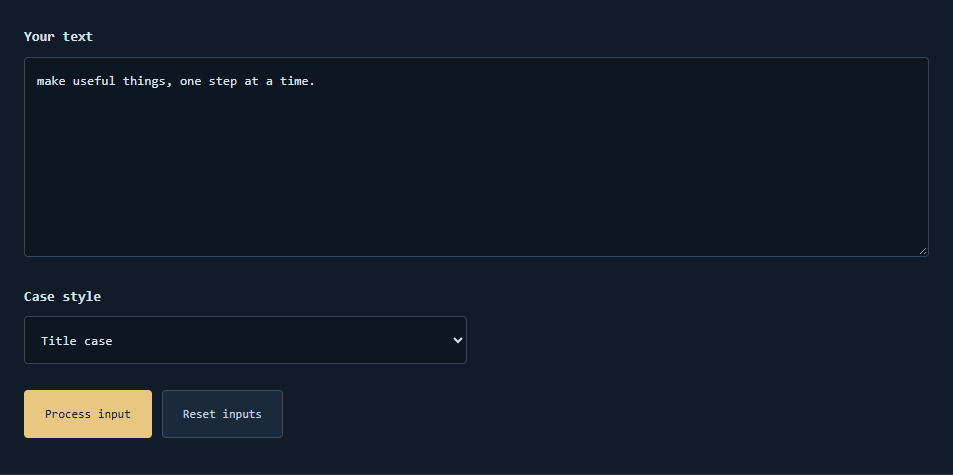
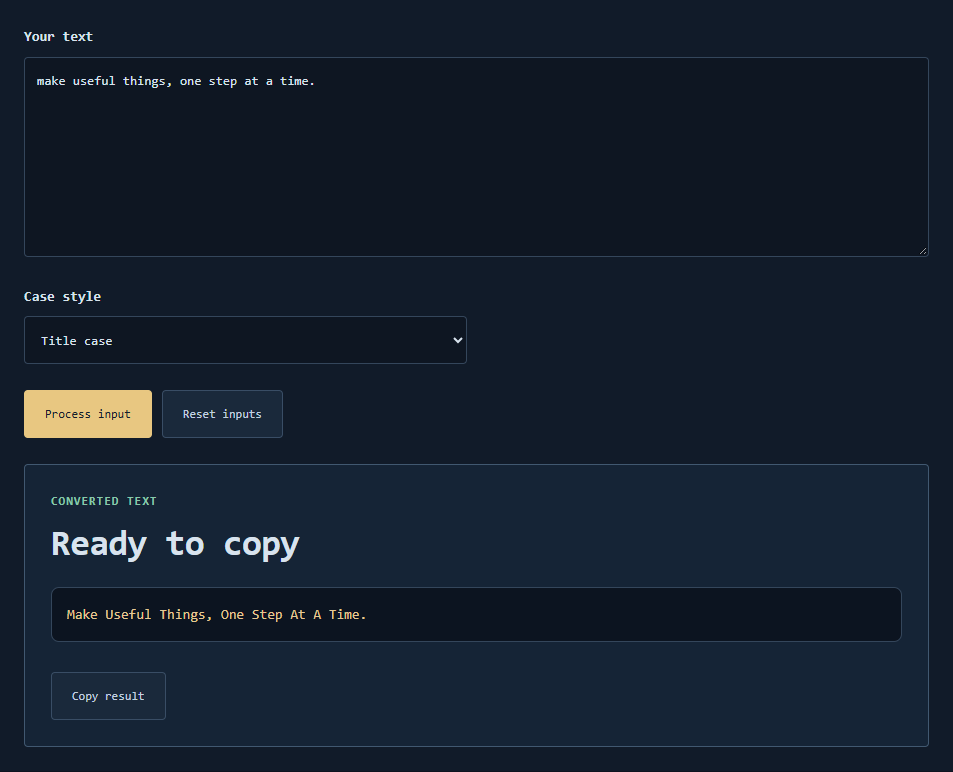
The case converter changes letter case with four explicit modes. Upper case and lower case call the browser’s Unicode-aware toUpperCase and toLowerCase. Title case lowercases the string first, then uppercases the first letter of each whitespace-separated segment using Unicode letter matching. Sentence case lowercases first, then uppercases the first letter of the string and the first letter after sentence-ending punctuation followed by space.
Useful scenarios
- Normalizing a headline pasted in inconsistent casing.
- Preparing a sentence-case description from an all-caps export.
- Quickly lowercasing identifiers before a code review discussion.
- Turning a list of plain words into rough title case for a draft outline.
- Checking how acronyms survive a lowercasing pass.
Rules to remember
Title case here is algorithmic, not a style-guide title case that leaves small words lowercase. “NASA” becomes “Nasa” after a title-case pass that lowercases first. Sentence case looks for ., !, or ? followed by whitespace; it will not detect every language’s sentence boundary. Non-letter characters stay in place.
Worked example
Input: the HTML guide — READY?
Upper: THE HTML GUIDE — READY?
Lower: the html guide — ready?
Title: The Html Guide — Ready?
Sentence: The html guide — ready?
Notice that “HTML” is not specially preserved. If you need house-style casing, finish by hand after the bulk transform.
Common mistakes
- Expecting Chicago/AP title-case exceptions for “of” and “the”.
- Running title case on code and breaking intentional lowercase APIs.
- Assuming sentence case understands abbreviations like “e.g.” perfectly.
- Forgetting that locale-specific casing (such as Turkish dotted I) depends on the browser environment.
Limits
Transformations stay in the page. They do not translate meaning, fix typography, or guarantee editorial style compliance. Review acronyms and product names before publishing.
Which mode should I pick?
Upper/lower for blunt normalization; sentence for paragraph drafts; title only for rough headings you will still edit.
Are emoji affected?
Letter mappings target Unicode letters; emoji generally remain unchanged.
Need a correction?
Send a sample and mode via the contact page.